I
PAINTING INDIA

Kottakupam Studio, Puducherry, ©V.Konetzki
It is a tight thread between Chennai and Paris.
It is a union beyond the borders.
It is combining pearl and pigment, canvas and embroidered thread.
It is a bet between two aesthetes.
It is an audacious collaboration blending an ancestral craft with gestures guided by intuition and mystery.
In 2011, painter Caroline Dantheny meets Jean-François Lesage, responsible for the precious link between the two sister-houses, Lesage Paris and Vastrakala established since the latter’s creation in Madras, India. From that unexpected collaboration was born a sincere friendship and works combining the vibrant force of abstract painting and the finesse of embroidery.
Today, embroidered canvasses are the subject of an exhibition in India, promising a journey beyond borders — keeping art’s flame shine.
What is a trace if not the irrevocable mark of time, the trail that weaves toward the wounded animal, the holes in the snow or the ink on the blotting paper ?
There is the joint trace to the gesture, the one rushing forward, slender, from the Japanese master to the untamed one, shaking itself on the contemporary painter’s canvas. There’s always a mystery, something todecipher in the trace that is the depositary of the gesture.
What senseless debacle happened on this gold-flooded canvas ?
D’Or et de Bois sombres bears the scars of a muddy struggle. One might imagine a single gesture racing across the surface — aerial or telluric — like a musical score where an army of violins rise before being cut short by a thunderous piano. A quasi-Wagnerian ascent, erupting violently, then dissolving into a sea of gold. A gesture striving toward immensity, seizing and carrying us with it.
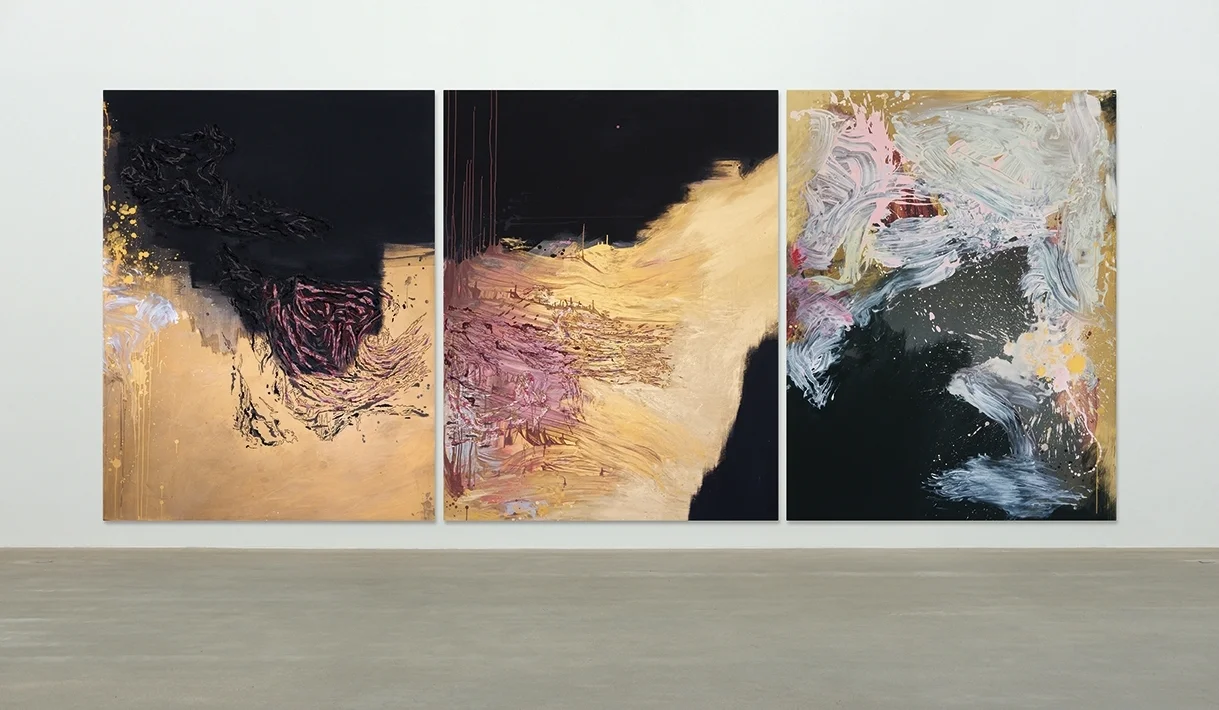
A triptych. A dialogue between three canvases. A narrative in three movements — the universal number that gives completion to the work. It could have been called L’Inachevé, yet the artist chose Le Dernier Royaume the entering gate to a marvelous world, far away and buried. Buried by that sky shaded by gemstones spreading on the painted canvas. Just like the joyful ants from Erumpu running maliciously to bite inches of paint maculated earth. That idea that embroidery might be the painted territory’s invader but also its precious ally once peace is reigning. Sometimes, like in this epic story unfolding before our eyes over three canvasses, the embroidery tells, by its absence : extinction, disappearance, loss. Its colonies of threads and materials, disappearing at the third chapter, sent away or defeated, but life is no less peaceful, on the contrary chaos spits in white tracks, a big visual anarchy interrupts the first two canvasses’ dialog and destroys the process between painting and embroidery. That surprising scream the artist masters is the card falling at the chosen moment for better surprise and to restrain our tendentious envy to grasp the work through the intellect, here of no help.
It is a painting speaking with an open heart, to all the open hearts, to the careless who feel disarmed facing the unknown. For there is only unknown : that of the artist before his content, of the embroiderer jabbing the dot, of the spectators watching, of the ones from this last kingdom of which we only know it will find its longevity through this work sewing its secret.
Victoria Konetzki

An idea
The birth of an idea is a curious thing, sometimes it springs from a picture, a word, an emotion or sometimes like in this project, from a conversation. A friend, also a painter, suggested that I should “think“ some of my paintings as tapestry.
The year then was 2010.
Back then, I aspired to connect my painting with my not so distant past in fashion and creation of unique pieces. I knew that somehow one day these two universes would collide. Embroidery appeared suddenly and with it, the name of Maison Lesage.
After this initial idea, came the first encounter with Jean François Lesage. We shared the same passion for the beautifull and the unexpected and we were already discussing our willingness to work together.
The richness of materials and the embroidery stiches associated with my painting paved the way to a broad field of possibilities.
Our collaboration began and the first embroidered painting was made in March 2013.
STORY TELLING
2010 – Contact
The collaboration between Caroline Dantheny and Maison Jean François Lesage began in 2010 in Paris. Introduced by Sophie de Montozon, then a close collaborator of Jean François Lesage, the two artists met in Dantheny’s studio on Rue Saint-Blaise.
From that first encounter, the possibility of a shared language became evident. A founding principle was immediately established: all painting and embroidery would be created in Tamil Nadu. Embroidery would not illustrate the painting, nor embellish it. It would intervene freely, independently — just as painting would remain sovereign— two autonomous practices meeting on equal ground.
March–June 2012 – First Visit
In the spring of 2012, Caroline Dantheny travelled to Madras (Chennai) with photographer Cyrill Brami, for an initial visit to the Vastrakala atelier.
Back in Paris, she began an intense period of research into embroidery techniques and materials. Maison Lesage opened its archives to her and entrusted her with rare and precious materials.
January–March 2013 – Charmiers Road, Madras
Dantheny set up her studio for two months on Charmiers Road in Chennai, in a building still under construction. There she painted her first diptych.
Guided by the expert eye of master embroiderer Jean-François Lesage, and working from archival samples, she developed her first embroidery maquette and after several weeks of meticulous work, La Source Jaillissante was completed.
Shortly thereafter, the artist fell ill and was hospitalized in Chennai before returning to Paris. Her recovery lasted several months.
January 2014 – Documentary
Film director Gaëlle Royer proposed a 52-minute documentary following the development of this artistic dialogue between Caroline Dantheny and Jean- François Lesage.
October 2014–March 2015 – Cholamandal & Poes Garden, Madras
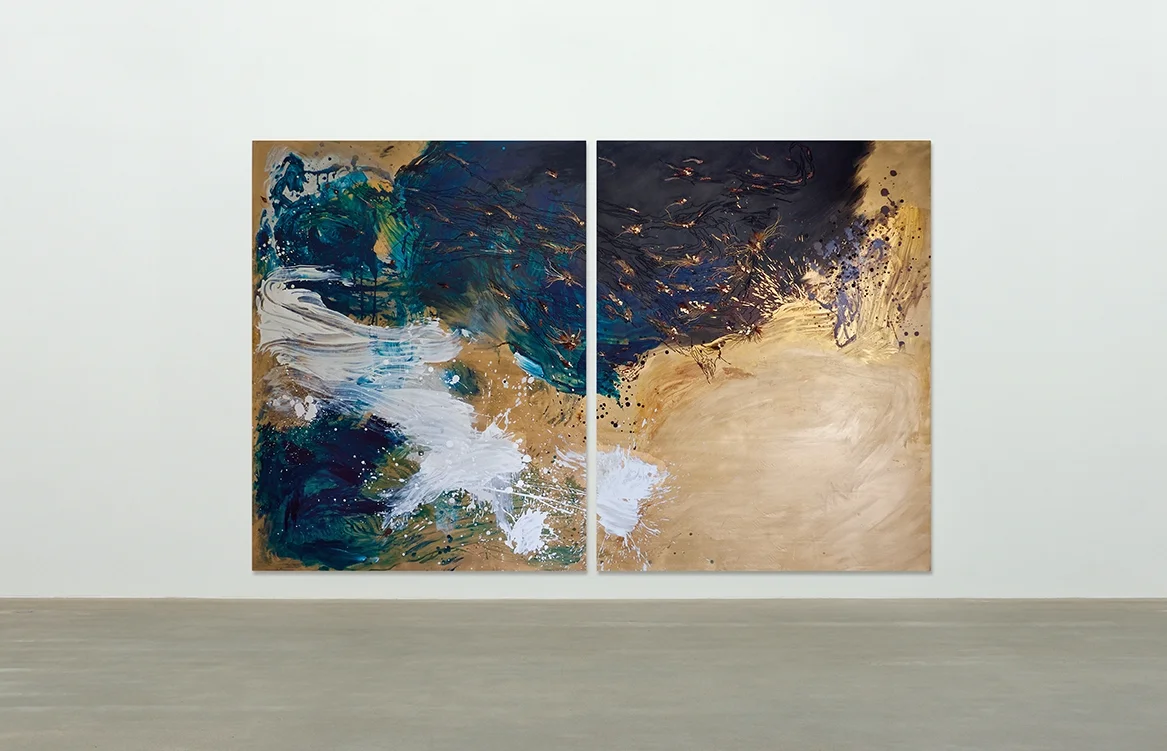
Dantheny returned to Tamil Nadu, establishing her studio for six month in Cholamandal, south of Chennai. Gaëlle Royer documented her daily life and working process for two months. During this period, Dantheny painted the monumental triptych Le Dernier Royaume and the diptych L’Oiseau Bleu.
The embroidered phase took place in a more intimate setting: Jean François Lesage’s private apartment in Poes Garden, in the heart of Madras. Installed there, the artist oversaw the embroidery of Le Dernier Royaume. A team of five to six embroiderers worked daily for six weeks. The embroidery alone required more than 1,800 hours of meticulous craftsmanship, embodying the convergence of contemporary pictorial gesture and traditional Indian savoir-faire.
Winter 2015 – Interruption
The devastating floods that struck Tamil Nadu in the winter of 2015 forced a temporary halt to all travel and production. Despite the tragic regional events, the canvases stored in Jean François Lesage’s apartment remained unharmed.
January–February 2016 – Return
In early 2016, Dantheny returned to India to locate a new studio space and to plan the next stage of painting and embroidery, preparing the continuation of the project.
October 2016–March 2017 – Kottakupam, Pondicherry
A new studio-home was established in Kottakupam, near Pondicherry. There, she painted several works, including La Source, Vents Marins, and Erumpu, conceived for subsequent embroidery.
An embroidery team joined her on site, successively embroidering Erumpu and L’Oiseau Bleu. The project fully took shape under the title Painting India.
January 2018 – Painting India, Chennai
The first major presentation of Painting India took place at Lalit Kala Akademi, Chennai, sponsored by the Alliance Française of Madras as part of the Bonjour India festival.
The works will all be made in Tamil Nadu, India, painting and embroidery (except D'or et de Bois sombres & Des Racines de la Terre).
The embroidery intervenes in an autonomous way, like the painting hence not to underline, signify or cover up paint tracks but as a new creative medium. Instead of intervening only with paint, I will do it with this new tool called “embroidery“. In order to sustain the surprise of this unexpected mix of mediums, I have decided to give myself total creative freedom. I shall paint without anticipation nor global vision and the intervention of the embroidery will come intuitively.
The embroidery is intimately linked with the painting, the small confronts with the big, the precious with the wild and the mastery with the disorganised.
It is a work that engages human cooperation, closely bonding two cultures, two different fundamental visions: India and France, the East and the West. This work is the ultimate testimony of this.
C.Dantheny

Sir Mahesh at work on L’Oiseau Bleu
Embroidered paintings & Paintings
1. Erumpu
2. D'Or et de Bois sombres
3. Le Dernier Royaume
4. La Source Jaillissante
5. L'Oiseau Bleu
6. Vulcano
7. La Source
8. Des Racines de la Terre
9. Vents Marins
10. À la Nuit
11. Masculin/Féminin
Elements of work
Layout printed on tracing paper
Prototypes of embroideries
Films
"Painting India", Gaëlle Royer
"La source Jaillissante", Caroline Dantheny
Dairy
Wall of pictures
Edition
"Painting India", 62 pages
1. Embroidered paintings & Paintings

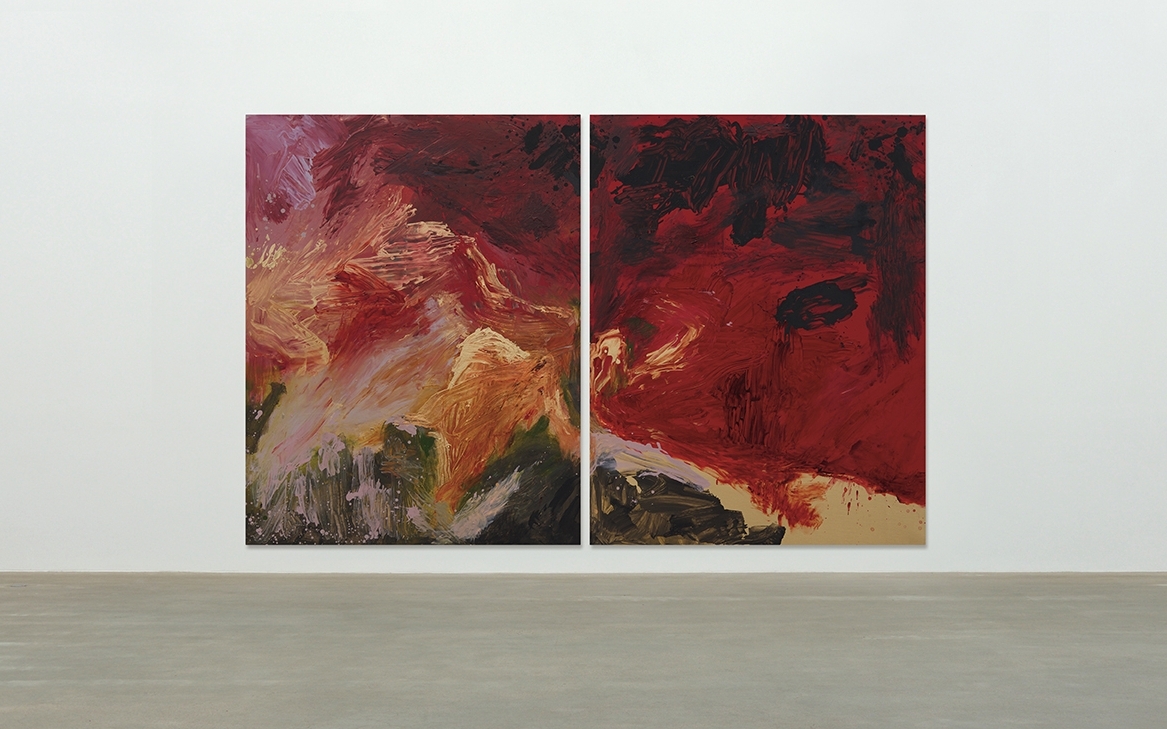


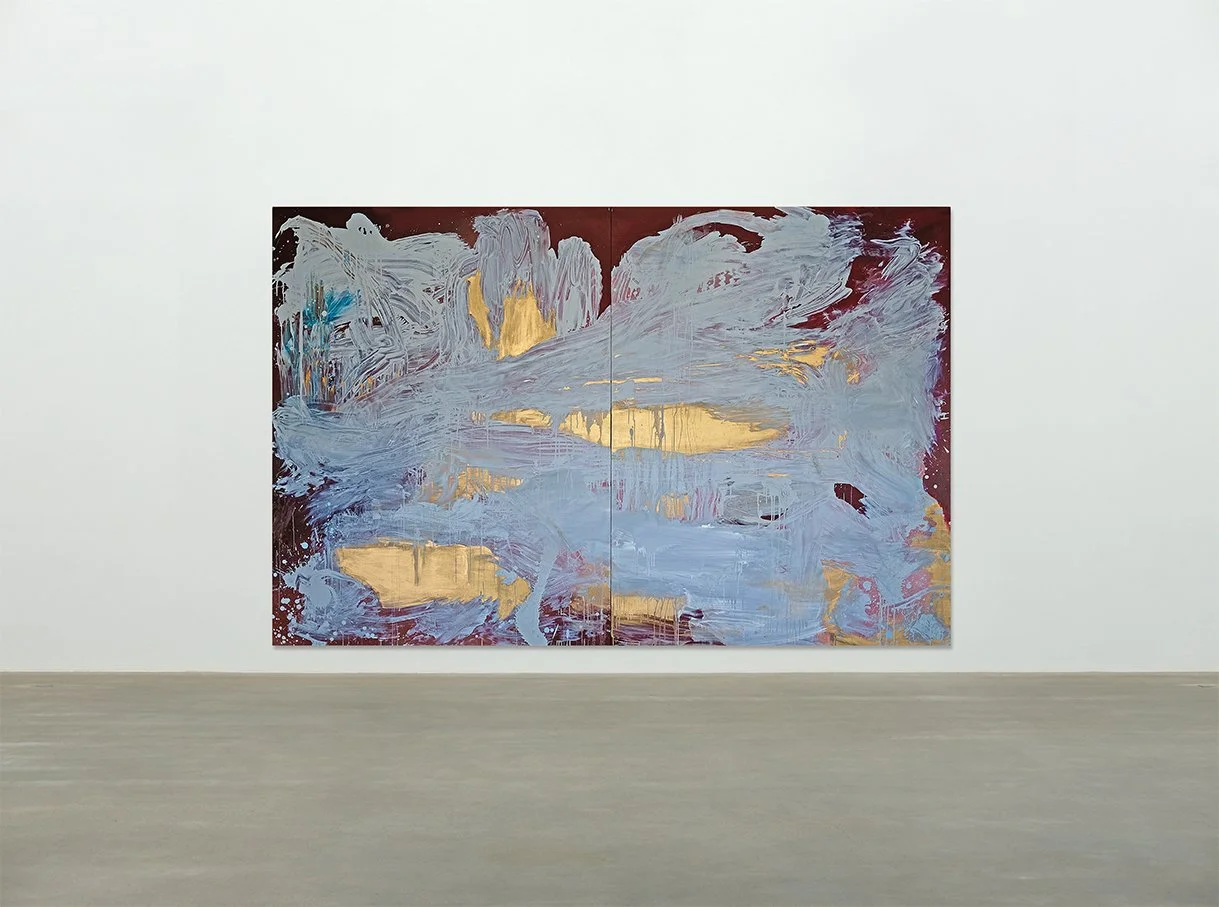

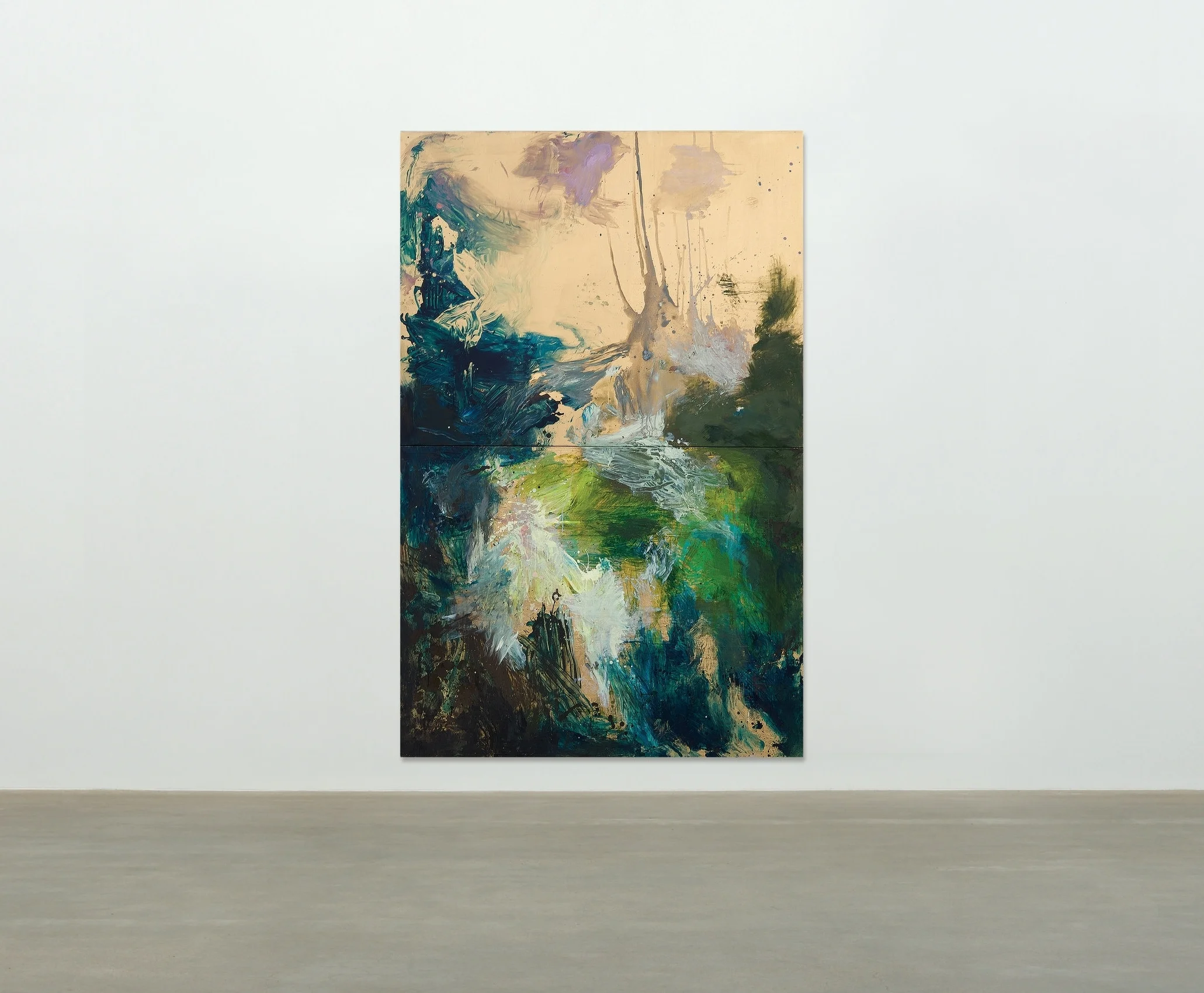
Des Racines de la Terre - Diptych composed of 2 panels of 153x198 cm - Mixed medias on canvas
2. Elements of work
Layout printed on tracing paper
"Dairy", Photos reportage
4. Edition
Livre, 56 pages